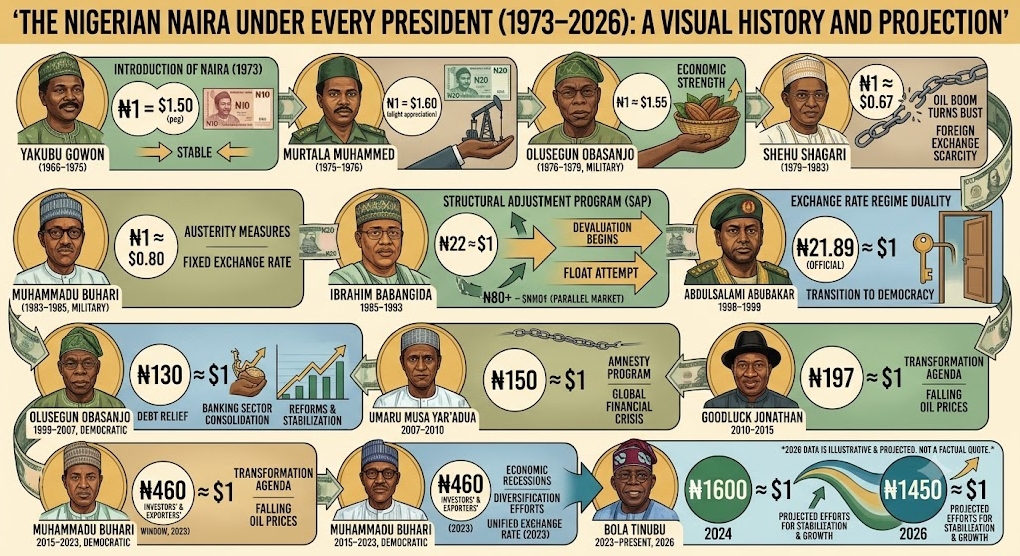
Few subjects generate as much discussion in Nigeria as the value of the naira. From its introduction in 1973 to today's foreign exchange market, every administration has inherited unique economic opportunities and challenges that influenced the country's currency. While many people blame individual presidents for the naira's decline, the reality is far more complex.
The value of any currency is affected by domestic policies, global oil prices, inflation, foreign reserves, investor confidence, international trade, and geopolitical events. This article examines how the naira evolved under every Nigerian President from 1973 to 2026, highlighting the major policies and economic conditions that shaped its journey.
If you're looking for today's exchange rates, compare the latest Black Market Rate, check the official CBN Exchange Rate, or calculate live conversions using the Aboki Dollar Currency Converter.
The Birth of the Naira (1973)
Nigeria officially introduced the naira on January 1, 1973, replacing the Nigerian pound with a decimal currency system. The change simplified financial transactions and reflected Nigeria's growing economic independence.
During the early years, Nigeria benefited from booming crude oil exports, giving the country strong foreign exchange earnings and supporting a relatively stable currency.
General Yakubu Gowon (1973–1975)
Although the naira was introduced during General Yakubu Gowon's administration, exchange rate management was relatively straightforward because Nigeria enjoyed substantial oil revenues following the global oil boom.
The naira remained one of Africa's strongest currencies during this period, supported by growing foreign reserves and increased government spending on national development.
General Murtala Mohammed (1975–1976)
General Murtala Mohammed's administration was brief, but it maintained many of the existing economic policies. Currency stability largely continued as oil revenues remained strong.
There were no significant exchange rate reforms before his assassination in 1976.
President Olusegun Obasanjo (Military Administration, 1976–1979)
Under General Olusegun Obasanjo's military government, Nigeria continued investing heavily in infrastructure using oil revenues.
Although the naira remained relatively stable, concerns about growing dependence on crude oil exports were beginning to emerge.
President Shehu Shagari (1979–1983)
President Shehu Shagari inherited declining oil prices, reduced government revenues, and increasing imports.
Economic pressure mounted as foreign reserves fell, making it increasingly difficult to sustain the naira's previous strength. Import restrictions and borrowing increased during this period.
General Muhammadu Buhari (1983–1985)
General Buhari's first administration introduced strict foreign exchange controls designed to protect the naira.
Rather than allowing market forces to determine exchange rates, the government tightly controlled access to foreign currency. While this helped limit official depreciation, it also encouraged the growth of an unofficial parallel foreign exchange market.
General Ibrahim Babangida (1985–1993)
Perhaps no administration changed the trajectory of the naira more than General Ibrahim Babangida's government.
In 1986, Nigeria adopted the Structural Adjustment Programme (SAP), introducing a market-driven exchange rate system recommended by international financial institutions.
The naira experienced significant depreciation as exchange rates became increasingly influenced by market demand and supply rather than government controls.
Many economists consider this period the beginning of the naira's long-term adjustment toward market valuation.
Chief Ernest Shonekan (1993)
Chief Ernest Shonekan's Interim National Government lasted only a few months. Economic uncertainty remained high, and the exchange rate continued facing pressure due to political instability.
General Sani Abacha (1993–1998)
General Abacha implemented tighter foreign exchange controls and introduced multiple exchange rate mechanisms.
Although official rates appeared relatively stable, significant differences emerged between official and parallel market exchange rates.
The existence of multiple exchange rates created market distortions that affected businesses and investors.
General Abdulsalami Abubakar (1998–1999)
General Abdulsalami Abubakar oversaw Nigeria's transition to democratic rule.
Economic reforms were limited during the transition period, but restoring investor confidence became a key priority.
President Olusegun Obasanjo (1999–2007)
Returning as a civilian president, Olusegun Obasanjo implemented significant economic reforms aimed at improving fiscal discipline, reducing debt, and strengthening foreign reserves.
Nigeria secured historic debt relief and experienced strong oil revenues, helping stabilize the economy despite gradual depreciation of the naira over time.
President Umaru Musa Yar'Adua (2007–2010)
President Yar'Adua's administration coincided with the 2008 global financial crisis.
Falling oil prices affected Nigeria's foreign exchange earnings, placing renewed pressure on the naira despite efforts to maintain economic stability.
President Goodluck Jonathan (2010–2015)
President Jonathan presided over rapid economic growth, telecommunications expansion, and Nigeria's GDP rebasing, which briefly made the country Africa's largest economy.
However, declining oil prices beginning in 2014 reduced foreign exchange inflows and increased pressure on the naira.
President Muhammadu Buhari (2015–2023)
President Buhari's civilian administration faced some of the most challenging economic conditions in recent history, including declining oil revenues, recession, the COVID-19 pandemic, and foreign exchange shortages.
The government implemented various exchange rate policies while attempting to preserve foreign reserves. Multiple exchange windows existed during much of this period, leading to noticeable differences between official and parallel market rates.
President Bola Ahmed Tinubu (2023–2026)
President Tinubu introduced significant economic reforms, including efforts to unify Nigeria's foreign exchange market.
The removal of fuel subsidies and exchange rate liberalization represented major structural changes aimed at improving market efficiency and attracting foreign investment.
While these reforms contributed to increased exchange rate volatility in the short term, policymakers argued they were necessary to create a more transparent and sustainable foreign exchange market.
Was the Decline of the Naira Caused by Presidents Alone?
The short answer is no.
Although presidential policies influence economic performance, the value of the naira has also been shaped by numerous external and structural factors, including:
- Global crude oil prices
- Foreign exchange reserves
- Inflation
- Population growth
- Import dependence
- Foreign investment
- International debt markets
- Global financial crises
- COVID-19 pandemic
- Changes in monetary policy by the Central Bank of Nigeria
According to the Central Bank of Nigeria, exchange rates are influenced by both domestic monetary policy and broader macroeconomic conditions. Financial publications such as Nairametrics and BusinessDay Nigeria regularly report on these interconnected factors.
Lessons from Five Decades of the Naira
The history of the naira demonstrates that no single administration completely determines a currency's value. Instead, exchange rates reflect decades of fiscal decisions, monetary policy, global commodity prices, investor confidence, productivity, and economic diversification.
As Nigeria continues pursuing reforms and expanding non-oil sectors, the long-term strength of the naira will depend on sustainable economic growth, increased exports, improved foreign investment, and sound macroeconomic management.
To stay updated on daily exchange rates, currency analysis, and economic developments, visit the Bureau De Change News section and explore exchange rates against major international currencies in the World Currencies hub.